Tuesday, August 13, 2019

My Baritone Saxophone as a Vehicle

Gerry Mulligan was the first person I ever heard of who played the baritone saxophone, and I wasn't drawn to it. I admired the tenor playing of Sonny Rollins, and when I talked my parents into buying my first saxophone for me - I was probably in tenth grade - I acquired a Selmer Mark VI, which I sold, to my lasting regret, when I decided I would never play saxophone again.
Much later, when I took up saxophone again, I heard someone playing a baritone sax in a quartet and couldn't imagine why anyone would play that instrument.
Nevertheless, a few years after that, I bought a clunky Grassi baritone from a musician who was retiring from the police band, and I played that for a while.
Then, when my father passed away, in 1992, I got a bit of unexpected cash with the settlement of his will, and bought my present instrument, a Selmer Superaction 80, with which I am more or less in love.
It took me a long time to sell the Grassi, and I don't miss it.
Owning a baritone saxophone is a bit like owning the ball when you choose up sides for a pick up game: you've got to be included, even if you aren't a great player.
I've played in wind orchestras, big bands, and saxophone quartets because I'm the one lugging the bari - and I've become a decent player.
In a few hours I'm going to attending a music workshop at the Jerusalem Academy of Music as a baritone player. True, the higher instruments get to play the melody more often, but for every baritone sax there are at least six altos and twelve clarinets.
An instrument takes you places both musically and physically.

Monday, June 10, 2019

What's a Musical Idea?

Years ago I took a course in musical cognition in the musicology department of the Hebrew University, and I was frustrated by the huge gap between the cognition that was the subject of the course and the cognition that interested and still interests me.
My interest in the subject was then related to my efforts to learn to improvise in jazz, and the course was concerned with the way the brain processes pitch and the other basic elements of music.
I'm still interested in musical cognition, in how a person thinks in the medium of music. I want to know how a concert pianist commits complex works to his or her memory, how a conductor learns a score and gets an orchestra to play it the way he or she wants it to be played, how a composer conceives of music before he or she writes it out, and how a jazz improviser invents a solo over the harmonies of a standard. The academic study of cognition is very far from explaining matters that complex.
In his popular lectures on music, Gil Shohat often speaks of something quite simple in a classical piano work, such as two descending notes, as a musical idea, which is repeated throughout the piece. While I see his point, and I cannot deny the presence of that feature in the piece, once he points it out to me, the descent from B to A, for example, seems much too simple to be called an idea.
Recently I have been trying to learn the first of Wilhelm Friedemann Bach's duets for two flutes, music that is so full of idea that it's hard to play and follow. I have been trying to give my practice meaning and direction by noticing his ideas and wondering just what I would call an idea if I were analyzing the piece.
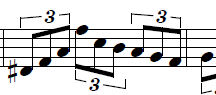
Here's the first measure of the piece:
How many musical ideas do these ten notes convey? One idea is the rhythm, the division of the three beats of the measure into nine triplets. Another idea is the spelling out of the e minor triad on the first beat of the measure, telling the listener (and player) what the key is. A third idea is jumping down from the high 'e' to 'b' and then continuing down the scale rather than extending the initial arpeggio. Yet another idea, and an interesting one, is turning the last note in the measure, the low 'e,' which ought to be, as it were, the resolution of the movement, into a passing note and landing on "d#" at  the beginning of the next measure, which echoes the shape of the first measure:
Thus, that shape is also a musical idea.
It would be tedious to go on, as my point is to point out the complexity of both musical ideas and the task of identifying them. Bear in mind, that these two measures appear before the second flute joins in and adds an exponential element to the piece.
Playing W. F. Bach's music is an enriching experience. My purpose in looking for the musical ideas as I learn to play the piece is to play it more intelligently, and also to keep up my interest and avoid playing mechanically as I play the piece over and over again in my effort to master it.


Sunday, June 2, 2019

My Solo and Benjamin Goodman's


On Friday morning, May 31, 2019, I stood up with my massive baritone saxophone dangling from a strap around my neck and played a song the Muppets made famous, “Ma Nah Ma Nah,” backed by the (very) amateur wind orchestra where I play every Tuesday night. Usually the baritone saxophone has a rather modest (though important) role in the pieces we play (things like songs from “West Side Story” and “The Pirates of the Caribbean”). It accompanies the rest of the orchestra, from the bottom, along with the other low instruments: tuba, trombone, and baritone horn. So, getting a chance to solo in front of the band was an unusual challenge and opportunity. I’m grateful to our young and energetic conductor, Yonatan Leneman, for asking me to do it.
My solo was not terrifically demanding, but it was jazzy and fun. I practiced very regularly and consistently, probably more than I had to, to get it right, and I was almost satisfied with the way I played. The venue was outdoors in the courtyard of the new state religious elementary school in the Israeli city of Mevaseret Zion, and the audience consisted of the pupils, their parents, and their grandparents. Before playing, I told the audience that I spent my first months in Israel in the Absorption Center at Mevaser Zion, in 1973, long before the city was developed intensively.
I took the assignment as seriously as though I were going to be on stage at the Jerusalem Theater, though I can’t say I was nervous. Excited, yes. And confident.
The night before my solo, we hosted a piano recital in our home by a young and extremely accomplished pianist, originally from England: Benjamin Goodman. He played an ambitious and difficult program, including works by Bach, Debussy, Liszt, and Schumann, for an intimate audience, mainly our friends. It was a thrilling performance. Benjamin has fantastic technique and plays communicatively with deep understanding. He spoke briefly, modestly, and informatively about the pieces before he played them, with his fine Oxford accent (“Waltz” came out “Woots”).
The difference between the high level of Benjamin’s playing and the profundity of the music he played puts my solo on “Ma Nah Ma Nah” in an ironic light, though I’m proud of myself for performing creditably.
I have a childhood prejudice for classical music. I was brought up to respect and appreciate it. My mother used to take me to Saturday matinee concerts at Carnegie Hall. I was taught classical piano for a few years, till I knew I was going nowhere with it. When I took up clarinet, the orientation was definitely classical, and I never rebelled. I love jazz and listen to it often. I admire the skill and musicality of jazz musicians. I heard a lot of folk music when I was growing up in Greenwich Village and attending a leftist school, where, when we were required by law to have a nuclear air raid drill (as if anything would have protected us if the Russians had bombed New York), we gathered in the basement of the school and sang peace songs. Since moving to Israel, I have also listened to a lot of Middle Eastern music and enjoy it. The skill of our players like Yair Dalal and Taiseer Elias thrills me. Nevertheless, at bottom, I prefer hearing Western classical chamber works (symphonies often are too bombastic for me – I have tried and failed to enjoy Mahler).
When I took up flute, I had a phone conversation with my prospective teacher and told him I was interested in playing baroque music. But right afterward I said I wasn’t interested only in baroque music. I wanted to master the instrument (I am getting closer, after more years than it would have taken a gifted high school student – indeed, more years than it took me to get to a higher level on clarinet when I was in high school). My idea was that I wanted to be able to play well enough to read duets with friends, not to perform. Though I did work on a piece by Schumann with a pianist and perform it for a home audience, at the end of the recital he gave at our house.
Now I’m working on flute duets by Wilhelm Friedemann Bach, complex and demanding music. I’ve been practicing the first one for a couple of weeks now and am still nowhere near to mastering it enough to imagine performing it. In fact, I doubt I’ll ever get there. I play it with my teacher in my lessons, and that’s about as public as it’s going to get. The pleasure of playing with him is elevating. And the effort to learn a piece well, and then to learn another one and another one, increases my respect for Benjamin Goodman infinitely.

Friday, May 17, 2019

Listening Mindfully to Yourself

Yesterday my flute teacher warned me that when I start working on the duets by Wilhelm Friedemann Bach (an older contemporary of Hayden and Mozart, but not exactly a classical composer, like his younger brother, Carl Philipp Emanuel), I have to be careful not to make concentration on the difficult notes distract me from the quality of my sound and musicality in general.
WFB's duets are full of unexpected rhythms and note choices (a direction beyond baroque toward rococo), making it interesting and challenging to play, but I see what my teacher means about focusing on overcoming the technical difficulties of mastering the pieces and trying to play them at the speed they're meant to be played at. I'm working on the first of the six duets now, and I've decided to play it slowly enough that I can hear every note that I play. Not that I don't try to hear what I'm playing whenever I play. But minds wander.
I'm consciously trying to turn my flute practice into a meditative exercise, listening to the notes the way I learned to pay attention to my breathing while meditating. Obviously the aim of playing this way is to have every note be full and focused, in time, in tune, and at the right level of dynamics. But, as an experiment, I'm not going to try to correct my playing, just to notice it. You can't improve something unless you are fully aware of what it is.
When you're taught mindfulness meditation, you're told to focus on your breath without trying to change it in any way by breathing more deeply or more slowly, or better in any way. You aren't preparing for a test in breathing. I think the same idea works when you play an instrument or sing. Which doesn't mean that one doesn't aspire to sound more beautiful. However, I have faith that it will happen as a result of non-judgmental awareness. Yes, my sound on the high 'e' as I played that arpeggio leading up to it didn't emerge at all, or it was too loud. I heard it. I will play that arpeggio again and listen to the high 'e,' and if it comes out better, I will notice that. I will also notice each of the notes leading up to the 'e.' But I won't scold myself if they don't sound the way I'd like them to sound. I'll play them a few more times, listening carefully to see if there's any improvement. If there is, fine. If note, I'll try again tomorrow.

Tuesday, May 7, 2019

finding the right thing to play

In my flute lessons I have been playing duets with my teacher. It's valuable to me to hear his sound and musicality, and it's enjoyable.
We played pretty much everything in a well-known collection of duets edited by Louis Moyse. Then I started printing out duets from a huge archive of flute music that I purchased from the Clarinet Institute of Los Angeles. I had found myself playing a fair amount of baroque music and wanted to move forward at least to the nineteenth century.
After poking around among the files in the archive, I discovered a Danish composer from the first half of the 19th century named Niels Peter Jensen (1802-1846), whose duets were fun to play and almost easy enough for me to sightread. After going through a set of six of those, I decided against playing more of his stuff and found a set of duets by the French composer, Benoit Tranquille Berbiguier (1782-1835, what a great name!), who is best known for a set of flute exercises that he composed. The Berbiguier music isn't much more challenging than the Jensen. When I first started playing it, I thought it was pedestrian, but it grew on me as I worked on it, and some of it, when I played it with my teacher, was quite lovely.
Amusingly, my teacher was unfamiliar with both the Jensen and Berbiguier duets, though he had no trouble at all reading his part when we played them, and I hope that was fun for him. He's about the age of my older children, and most of his students are kids, so it must be a welcome change for him to be working with a mature person.
At my next lesson I plan to finish with the Berbiguier duets and move on to something much harder (and more interesting), the duets by Wilhelm Friedemann Bach (1710-1784), which are bringing me back toward the baroque, but WFB was an idiosyncratic composer, and his duets are quirky and challenging, full of unexpected notes and rhythmic figures.
The problem for me (my teacher doesn't assign music) is to find a level that's easy enough for me to play satisfactorily (though I don't aspire to get up to performance level) but still challenging, and not frustrating.

Tuesday, April 30, 2019

Musical Gear and Sound Concepts

Men (especially) are into gear: golf clubs, fishing tackle, cameras, and musical instruments, and accessories.
I moved through three flutes before settling on my excellent Sankyo silver flute. First I bought a used flute made by the Blessing company long ago, when they still made flutes (now, I think, they make tubas and such). Then I bought a slightly better used flute, an Armstrong. I played that until my flute teacher said that I'd made enough progress to deserve a better flute, and I bought a DiZhao flute that had been privately imported to Israel by a flute student who hoped to make some money by dealing in instruments (and soon gave up the idea).
That flute was a nice instrument with open holes and a B foot, and I played it for two years or so. Then I took it to Ginzberg, the excellent instrument store in Tel Aviv, intending to trade it in for a slightly better used instrument. However, I was persuaded to buy a much better used instrument, for considerably more than I had intended to spend, after spending comparing a number of flutes for quite a long while.
Last winter, on a trip to the US, I went to the Flutistry store in Boston, thinking I could improve on the Sankyo either by trading it in for a slightly better instrument or buying a new head joint. The people at Flutistry reassured me that I hadn't overpaid drastically for  my instrument, and that it was a very good one. So I decided to see about improving on then head joint. After trying out a dozen or more of them, I ended up buying a second hand head joint by Emanuel, a highly reputed Massachusetts flute maker. I was convinced that it gave me a richer sound than the one that came with the Sankyo.
Over the months that I've been playing on the new head joint, my sound has improved (at least to my own ear, and my teacher is pleased). Erica Schiller, the vice president of Flutistry, who helped me pick the head joint, spoke about "sound concept," which is not a term I was familiar with, but I like it. The Emanuel head joint has enabled me to produce a tone closer to my concept of the tone I would like to have.
This morning, just out of curiosity, as it were, I took out the original Sankyo head joint and tried it out again, playing the same thing first on it and then on the Emanuel, and vice versa. The truth is, I could barely hear or feel any difference. So, did I waste the money I laid out on the Emanuel head joint? I don't think so. I think the new head joint taught me to play closer to the way I hope to play, and, having learned that, I was able to get a similar sound from the old head joint.
By way of demonstration, at one of my lessons my teacher had forgotten to bring his own flute with him and was playing the Armstrong flute I once owned, which I donated to the conservatory where he teaches. He has a full, strong, focused sound on his professional quality flute, and, not surprisingly, when he was playing the Armstrong student flute, he had a full, strong, focused sound. That's the way he plays.
Gear can only get you so far.

Monday, March 25, 2019

Abundant Availability

The saxophone quartet I play in (I couldn't call it "my" quartet) has a number called "Black and White Rag." We had a disagreement about how to play it. One of us thought the eighths should swing, but the others said that was wrong for ragtime style, so I looked it up on Youtube. Sure enough, I found a recording based on the player piano roll, probably recorded by the composer himself, George Botsford, and the eights are played straight! Later on I found a recording of a sax quartet playing the piece, but I won't put in the link because the sound is very muddy, and they were playing it much too fast.
Now I take it for granted that I can( simply type in the name of a piece, a musician, or a composer, and almost without doubt I'll be able to hear what I want to hear in a minute or less. But when I started taking music lessons, to hear what you wanted to hear (Reginald Kell, say, when I was taking clarinet in high school), you had to have access to a good music library and go there, or a good record store, go there, and buy the record.
The abundance of available music changes everything (musically, at any rate). If you're learning a piece, you can hear a great musician play it, often more than one great musician in more than one rendition. This can be inspiring, instructive, or discouraging. I'll never be able to play a Bach sonata on the flute as well as the masters whose recordings I've listened to.
Performing musicians lose out on royalties for their CDs when people upload them to Youtube, and I don't imagine that streaming services like Spotify pay them very much. On the bright side, presence on the web can attract live audiences to concerts, and in any case a lot of people, like me, prefer live music to recorded music.
Right now I'm listening to a Canadian saxophone quartet playing ragtime arrangements. They're better than we are, and it's useful to hear just in what ways they outdo us. If we rehearse enough, maybe we'll get closer to their level.