Sunday, October 20, 2019

The Music of Jewish Prayer (and something about my music)

Judit Niran Frigyesi's book, Writing on Water, the Sounds of Jewish Prayer, is about a unique kind of music: the way that traditional Hungarian Jews used to chant their prayers. As she describes it, the chanting is inseparable from the words of the prayers, and the meaning of prayer is conveyed as much by the chant as by the words.
The word "chant," is my own. Figyesi does not use it at all in reference to the prayers she describes. The basic musical foundation is what we would call nusah in modern Hebrew (she renders the word in the Ashkenazic pronunciation of her informants: nisech). Cantors improvise on this foundation and add melodies. The Jewish men whose prayer she studied would never think of praying without this chanting.
They were children in the 1920s and 1930s, and they grew up learning to pray, with melody, as they learned how to talk.
Toward the end of the book, Frigyesi describes the revival of the Hungarian Jewish community after the collapse of Communism, in the mode of Modern Orthodoxy, which is essentially the kind of Judaism I have come to know here in Israel.
It's not the same thing.
But many musical experiences are deeply meaningful and not the same thing. Judit describes the many concerts she went to when she was a high school student and then a student at the music academy, and she also describes the experience of recording Gregorian chants with a chorus of which she was a member.
Neither Judit nor I can make ourselves into the elderly Holocaust survivors she describes, who kept alive the organic Judaism of their childhood. For me, music is something largely separate from my religious observance, though when I attend services I am carried along by the music and join in the singing. This morning I had an unexpected and unfamiliar feeling while I was practicing flute: I suddenly felt as if someone else were playing, and I was both standing outside it and doing it.
This is connected with to what Frigyesi writes about music and prayer.
I wonder whether I will ever recapture that feeling.

Wednesday, October 16, 2019

Another Opera

I attended a broadcast of the Metropolitan Opera Company's production of Turandot by Puccini, an extravaganza. Everything was on the highest professional level: the singing, the orchestra, the staging, the costumes, and the sets. And it was mainly sublime.
Because it was broadcast, there were English subtitles, and I knew exactly what they singing and what was going on in the plot, which is, to my mind, offensive. At the moment I' listening to a Youtube clip of the opera performed by the Wichita Opera Company, a production that probably cost fifty times less than the Metropolitan production. But it sounds pretty damn good.
What was the point in the mid-1920s, of writing an opera based on a Persian folk tale, transposed to China, about a princess who, to avoid marriage, arranged to have her suitors beheaded, until, along comes a hero who solves her three riddles and forces her to marry him? Did it mean anything to a continent recovering from a murderous war, on the brink of political crises that eventually led to another, even more murderous war? Did it have any plausible relevance then? or now? Are we to take this as a serious exploration of the myth of the femme fatale? Or is it just an operatic convention?
My take on it is that a serious exploration of the mythical dimensions of the plot would be a waste of intellectual energy. The ridiculous plot is merely an occasion for fantastic singing and musical performance. It's trivial.
But I'm not an opera fan. I find it astonishing that people are prepared to spend so much money on staging operas and attending them. That people train for years and years to become opera singers. That composers still write operas. I acknowledge that they are a significant part of Western musical and theatrical culture, and it's impressive that a city as small as Wichita, Kansas (fewer than 400,000 population) should have such a high level opera company.
Still, what's the point?
Later this year I'm going to attend a couple of more Metropolitan broadcasts. Maybe I'll be converted.

Friday, September 27, 2019

Books and a Concert - Why Bother Staging a Handel Opera?

I recently read two books about music: How Shostakovich Change my Mind by Stephen Johnson and An Equal Music by Vikram Seth. The former is by a music critic who responds very deeply to music and who was helped to deal with his bi-polar mental state by listening to Shostakovich. The latter is a novel narrated by an English violinist, and its very much about the experience of playing in a string quartet and the meaning of music in the protagonist's life. Last spring I read Romain Rolland's long novel, Jean-Christophe, which is about a composer, for whom music is the most meaningful thing in his life. All three books illustrate the difficulty of writing about music.
How does one avoid getting technical when talking about music? How does one share one's personal experience of music with people who might be equally moved by the music that moves one, but who associate it with entirely different emotional experiences? And, in general, how does music arouse emotion in the listener? What kind of emotional experience does music offer?
I wrote rhetorical questions just now, because there are, as far as I know, no good answers to them.
Last night I went to a performance of Handel's Orlando Furioso, an opera based on Ariosto's vast poem, which in turn, is based (loosely) on the Old French epic, La Chanson de Roland. This opera is rarely performed, for good reason, and it raises more questions about music.
The music is heavenly, of course. It was performed marvelously by Israeli singers from the Tel Aviv Opera Company, accompanied by fine musicians. But the story is ridiculous. The proposition of representing Orlando's insanity with stately baroque music is nearly a contradiction in terms.
I love baroque music. Recently I have been working on Telemann duets for two flutes. But for me, the main emotion that it conveys is that of marveling at its abstract beauty (though the religious emotions conveyed by Bach's cantatas is certainly palpable). However, secular passions, such as romantic love, were often regarded as threatening in the eighteenth century, the Age of Reason, as it used to be called simplistically, and the purpose of music was not to express and wallow in emotion so much as to crystallize and control it.
The Henry Crown Auditorium was packed with mainly elderly music lovers, and I found myself wondering what drew them to it and what they got out of it. Attending a concert of classical music is a bit like attending religious services, a way of confirming one's values and solidarity with those who share them, adulation of Western Classical Music. That holds for me, as well.
However, I was puzzled by the opera itself, wondering what it could have meant to the listeners for whom it was intended, and by what it could possibly mean for us today? According to the program, and I knew it anyway, Ariosto's impossibly long poem was one of the most influential works of literature written in the 16th century. Today it is probably unread and unreadable. Maybe that's the main thing we have to learn from the opera and the poem it's based on: how far away we are from there.
I applaud the performance of this opera, especially since it was done so well, and I'm glad I attended, but it didn't make me want to hear the other forty-one operas that Handel wrote.

Tuesday, August 27, 2019

A Useful Ear-Training Exercise

Helmut Eisel, a German Klezmer clarinetist, one of the teachers at the workshop I just attended in Jerusalem, directed useful sessions in improvisation (as did Raul Juarena, a master of the bandoneon, a kind of button accordion widely used in tango). Helmut, without knowing it, echoed a lesson of my musical guru, Arnie Lawrence: you don't play an instrument, you become an instrument. This is how Helmut interprets the word "klezmer," a Yiddish word that comes from two Hebrew words: kli (a vessel or tool) and zemer (song). In Helmut's view, all true musicians are klezmerim, vessels of song. I'll buy that.
However, this is a challenging proposition even for very gifted musicians, though you see and hear it when great musicians play. Emil Aybinder, whose workshop I attended, plays the accordion, a heavy, clumsy instrument (in my opinion) as if it were a part of his body, without thinking about where his fingers should go, how he should move the bellows, or what sound quality he wants. He just plays. The music flows out of him.For a musician of Emil's skill, there appears to be no gap between what his inner ear imagines and what he plays on the accordion. That's the result of years of intense, committed practice, based on inborn musicality.
Getting back to Helmut's lesson, although we were at a klezmer workshop, he gave a session about playing the blues - elementary but helpful for me, even though I've been playing blues for a long time. (Incidentally, it's important to be able to learn from music classes even when they are at a level far more elementary than yours; one must always go back to fundamentals.)
In his class, Helmut suggested the following exercise, claiming that within weeks it would take effect, and we would be able to improvise well: (1) play a note on your instrument; (2) sing that note; (3) sing a simple melody starting on that note; (4) play the melody on your instrument. (5) start over again.
I'm not a natural musician. I find it difficult to play by ear. I don't like the way I sing. But I'm determined to keep at Helmut's exercise. I've been doing it with the flute, which is somewhat difficult for a man who sings an octave below what the flute plays. I've only done it for a few days, so I can't vouch for the results yet. But I'm hopeful.
Incidentally, this exercise is similar in many ways to one suggested by Robert Dick, who has posted a lot of useful clips on flute technique, one of which is to hum into the flute while you play.

Monday, August 26, 2019

Report from Yet Another Workshop

This summer I took part in the annual Klezmer workshop at the Jerusalem Academy for Music and Dance: 7 days of playing music with other musicians. I took part in the Balkan Music ensemble, led by the accordion virtuoso, Emil Aybinder. Emil was not particularly interested in me as a musician, as he saw his purpose as encouraging the young musicians in our group to practice fanatically in order to become successful professionals. I didn't mind.For me, participating in the workshop was confirmation that I can learn to play a new style  of music, and I can grow as a musician, even at my advanced age. Also, playing with young musicians is a kick.
Here's a video of one of our performances.

Among the teachers at the workshop were two world class clarinetists: Corrado Giufreddi and Franklin Cohen. I attended their master classes and saw and heard how they work with young musicians, and I also heard them perform. What a privilege!
In addition, a quartet based in Munich also came, the Gitanes Blondes. They have played a lot with Giora Feidman, one of the musicians responsible for reviving Klezmer music. Playing with them was fun and inspiring.
Best of all, these great musicians were all friendly and accessible, modest, if you will.

Tuesday, August 13, 2019

My Baritone Saxophone as a Vehicle

Gerry Mulligan was the first person I ever heard of who played the baritone saxophone, and I wasn't drawn to it. I admired the tenor playing of Sonny Rollins, and when I talked my parents into buying my first saxophone for me - I was probably in tenth grade - I acquired a Selmer Mark VI, which I sold, to my lasting regret, when I decided I would never play saxophone again.
Much later, when I took up saxophone again, I heard someone playing a baritone sax in a quartet and couldn't imagine why anyone would play that instrument.
Nevertheless, a few years after that, I bought a clunky Grassi baritone from a musician who was retiring from the police band, and I played that for a while.
Then, when my father passed away, in 1992, I got a bit of unexpected cash with the settlement of his will, and bought my present instrument, a Selmer Superaction 80, with which I am more or less in love.
It took me a long time to sell the Grassi, and I don't miss it.
Owning a baritone saxophone is a bit like owning the ball when you choose up sides for a pick up game: you've got to be included, even if you aren't a great player.
I've played in wind orchestras, big bands, and saxophone quartets because I'm the one lugging the bari - and I've become a decent player.
In a few hours I'm going to attending a music workshop at the Jerusalem Academy of Music as a baritone player. True, the higher instruments get to play the melody more often, but for every baritone sax there are at least six altos and twelve clarinets.
An instrument takes you places both musically and physically.

Monday, June 10, 2019

What's a Musical Idea?

Years ago I took a course in musical cognition in the musicology department of the Hebrew University, and I was frustrated by the huge gap between the cognition that was the subject of the course and the cognition that interested and still interests me.
My interest in the subject was then related to my efforts to learn to improvise in jazz, and the course was concerned with the way the brain processes pitch and the other basic elements of music.
I'm still interested in musical cognition, in how a person thinks in the medium of music. I want to know how a concert pianist commits complex works to his or her memory, how a conductor learns a score and gets an orchestra to play it the way he or she wants it to be played, how a composer conceives of music before he or she writes it out, and how a jazz improviser invents a solo over the harmonies of a standard. The academic study of cognition is very far from explaining matters that complex.
In his popular lectures on music, Gil Shohat often speaks of something quite simple in a classical piano work, such as two descending notes, as a musical idea, which is repeated throughout the piece. While I see his point, and I cannot deny the presence of that feature in the piece, once he points it out to me, the descent from B to A, for example, seems much too simple to be called an idea.
Recently I have been trying to learn the first of Wilhelm Friedemann Bach's duets for two flutes, music that is so full of idea that it's hard to play and follow. I have been trying to give my practice meaning and direction by noticing his ideas and wondering just what I would call an idea if I were analyzing the piece.
Here's the first measure of the piece:
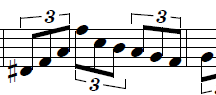
How many musical ideas do these ten notes convey? One idea is the rhythm, the division of the three beats of the measure into nine triplets. Another idea is the spelling out of the e minor triad on the first beat of the measure, telling the listener (and player) what the key is. A third idea is jumping down from the high 'e' to 'b' and then continuing down the scale rather than extending the initial arpeggio. Yet another idea, and an interesting one, is turning the last note in the measure, the low 'e,' which ought to be, as it were, the resolution of the movement, into a passing note and landing on "d#" at  the beginning of the next measure, which echoes the shape of the first measure:
Thus, that shape is also a musical idea.
It would be tedious to go on, as my point is to point out the complexity of both musical ideas and the task of identifying them. Bear in mind, that these two measures appear before the second flute joins in and adds an exponential element to the piece.
Playing W. F. Bach's music is an enriching experience. My purpose in looking for the musical ideas as I learn to play the piece is to play it more intelligently, and also to keep up my interest and avoid playing mechanically as I play the piece over and over again in my effort to master it.